Swans of the Kremlin by Christina Ezrahi
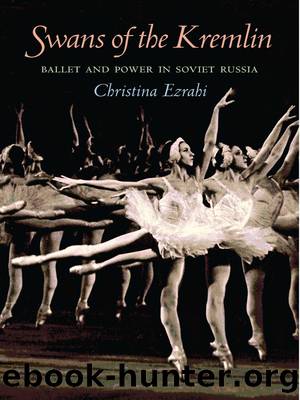
Author:Christina Ezrahi
Language: eng
Format: epub
Publisher: University of Pittsburgh Press
Constraining and Enabling Aspects of the Other
Despite these criticisms, on the artistic balance sheet of the cultural Cold War, the Bolshoi's visit clearly scored points for the Soviet side. In addition to stimulating a debate about the respective merits and artistic identity of Russian and Western ballet, the press predicted that the enormous public success of the Bolshoi's London visit would have implications for the future of ballet in Britain. The Times argued that the Royal Opera House had âgained in national esteem from the Bolshoi visitâ and speculated that the visit might have won a new audience for ballet in England, pointing out that âthe Bolshoiâ¦has made more propaganda for the art of ballet in a month than dancers, critics, and balletomanes usually manage in a year.â If only a small fraction of these people continued to go to the theater to watch the British ballet after the Bolshoi left, âthe effect upon the future will be every bit as powerful as the influence the visit has already had on critics and dancers.â66
From an artistic point of view, despite criticisms of the lack of innovative choreography, the theatrical concept behind drambalet, and Lavrovsky's Romeo and Juliet in particular, had a lasting impact on the development of British ballet, demonstrating that, contrary to Western expectations, not all artistic creativity was stifled and some art of value had been created under Stalin. The artistic influence of the Bolshoi's dramatic ballets on choreographers such as Kenneth MacMillan, John Cranko, and maybe even Frederick Ashton is undisputed and has been pointed out by their biographers.67 Lavrovsky's Romeo and Juliet deeply impressed and influenced Kenneth MacMillan, one of the Royal Ballet's defining choreographers. MacMillan's first full-length ballet for the Royal Ballet, his own version of Prokofiev's Romeo and Juliet, created almost ten years after he had first seen Lavrovsky's ballet, exemplifies the impact of the psychological character development and general dramatic coherence of the Bolshoi's production. Ninette de Valois wrote in 1985, almost thirty years after the Bolshoi's 1956 visit, that âany production of Romeo and Juliet owes much to Lavrovsky and Prokofiev. Scenically and choreographically the original may have been surpassed many times, yet all of today's productions bow, intentionally or unintentionally, to the basic craftsmanship and unified development of the original Russian productionâ¦. Prokofiev's Romeo and Juliet is a yardstick by which composers, choreographers, designers and scenario-writers may well study the structure of a full-length ballet for some time to come.â68
Today, MacMillan's Romeo and Juliet is a favorite in the international ballet repertoire, but at the time it stood in the shadow of Lavrovsky's production. After the Bolshoi's Covent Garden season in 1963, the Royal Ballet had hoped that Lavrovsky might mount his Romeo and Juliet for the Royal Ballet, while the Bolshoi might in turn acquire Frederick Ashton's La Fille mal gardée.69 After discussions led nowhere, MacMillan was commissioned to create the Royal Ballet's own version of Romeo and Juliet. Premiered in 1965, MacMillan's Romeo and Juliet was a big success.
Download
This site does not store any files on its server. We only index and link to content provided by other sites. Please contact the content providers to delete copyright contents if any and email us, we'll remove relevant links or contents immediately.
Twisted Games: A Forbidden Royal Bodyguard Romance by Ana Huang(4031)
The Push by Ashley Audrain(2703)
Den of Vipers by K.A Knight(2701)
Win by Harlan Coben(2665)
Echo by Seven Rue(2248)
Baby Bird by Seven Rue(2224)
Beautiful World, Where Are You: A Novel by Sally Rooney(2181)
A Little Life: A Novel by Hanya Yanagihara(2155)
Iron Widow by Xiran Jay Zhao(2127)
Leave the World Behind by Rumaan Alam(2100)
Midnight Mass by Sierra Simone(2015)
Bridgertons 2.5: The Viscount Who Loved Me [Epilogue] by Julia Quinn(1796)
Undercover Threat by Sharon Dunn(1791)
The Four Winds by Hannah Kristin(1775)
Sister Fidelma 07 - The Monk Who Vanished by Peter Tremayne(1670)
The Warrior's Princess Prize by Carol Townend(1632)
Snowflakes by Ruth Ware(1602)
Dark Deception by Rina Kent(1570)
Facing the Mountain by Daniel James Brown(1554)
